
Berlin’s hidden symbols: 6 details that nobody notices
As an amateur traveller, I’ve always loved exploring city streets. It was on the streets of Bangkok that I wore out my favourite pair of flip-flops. Without a doubt, walking is a solid, worthwhile option that tops the list of ways to explore a city, and is recommended by the vast majority of travellers.
So here you are in the city centre, taking in the architecture and checking out a few good spots, yet you’d like to know more about that statue, that street, or that iconic building. Cities are full of details and symbols that are easily overlooked.
As for Berlin, with its Prussian heritage, a past tinged with communism, and historic monuments to be found in every neighbourhood of the city, I thought a short article on the hidden symbols on Berlin’s buildings might delight a few enthusiasts.
It’s a lucky day, and with a touch of SEO magic, I invite you to follow in my footsteps around Berlin to discover its hidden symbols. Of course, I won’t be combing through the whole city, but I’d like to take you on a tour with a few stops in the heart of the German capital.
As for the tour route, I’ve included a map in the article. If you’re doing the whole thing on foot, it’s entirely up to you how you want to enjoy the walk: a leisurely stroll or exploring neighbourhood by neighbourhood, anything goes!
Alexanderplatz: The Pope’s Revenge

To begin our exploration of Berlin’s hidden symbols, which almost nobody notices, let’s head to one of the hubs of Berlin-Mitte: the very concrete-filled Alexanderplatz. To do things properly, we’ll limit our investigation to this area, so let’s focus our attention on the “Fernsehturm”, the large, unmissable tower, and the Neptune Fountain.
To be honest, I’m really pleased to start with a little-known fact that I learnt recently and am delighted to share with you. A brief historical background: the Fernsehturm was built by the GDR. In short, the GDR saw this almost pharaonic structure as an opportunity to showcase a symbol of the modernity of socialism. However, an unexpected detail was to get on the party leaders’ nerves a little.
When the sun shines at its brightest, its light reflects off the tower’s metal sphere, forming a luminous cross. Mystical or not, this recurring phenomenon is now known as the ‘Pope’s Revenge’, as if to thumb its nose at an officially atheist regime.
Ready to investigate Berlin ?
The Neptune Fountain: A symbol of Prussian power
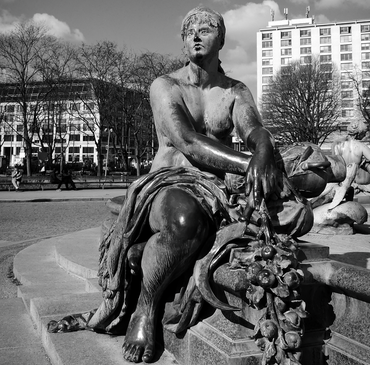
.The Neptune Fountain, “Neptunbrunnen”, is well worth a look. Now, let’s take five minutes to examine the details. Neptune symbolises the power of water and the prosperity associated with rivers, which indirectly alludes to Prussian power.
The four female figures represent the four major rivers of the Kingdom of Prussia: the Rhine, the Elbe, the Oder and the Vistula. Whilst your friends will see art and well-crafted street furniture, you can point out that there’s a bit of geography involved too! Note that the fountain was moved in the 1960s. It used to be attached to the Imperial Palace (Berliner Schloss).
Impacts at Am Kupfergraben
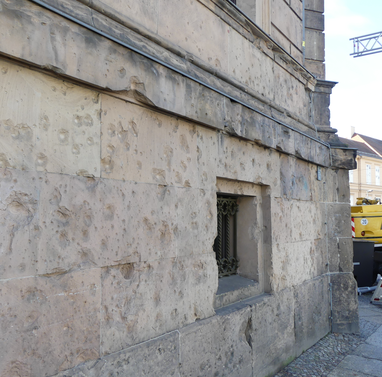
Let’s continue our list of hidden symbols on Berlin’s buildings with a quick detour to the street known as “Am Kupfergraben”. Take a few minutes to look up at the wall. Notice the bullet and shell marks left here during the Second World War. These are the scars of the 1945 Battle of Berlin between Soviet forces and the German army.
Bebelplatz, the empty library

As you’ll have gathered from the example above, not all the symbols hidden in the streets of Berlin are cheerful. Unfortunately, we’re going to continue with an allegory that isn’t exactly cheerful either. We head to Bebelplatz to discuss the book burning of 1933. It was at this time, no doubt spurred on by the rise of fascism and Nazism, that students burned 20,000 books in a bid to combat the “un-German spirit”.
A fresh scar on Germany’s history in the streets of Berlin, Bebelplatz features a glass panel set into the cobblestones at its centre. Stand over this panel and you will see an empty bookcase beneath it, evoking the memory of those books reduced to ashes.
Statue of Schiller at the Gendarmenmarkt, a cultural icon of the 18th century
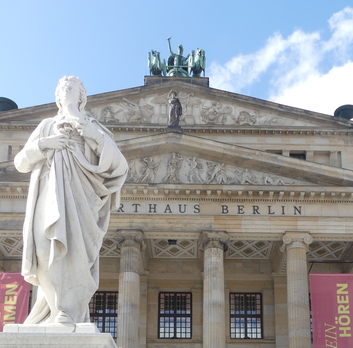
Sorry, I didn’t mean to spoil the mood, but we can always tell ourselves that one of the reasons for fighting obscurantism is culture. And that’s just as well, because if you want to keep deciphering the hidden symbols on Berlin’s buildings, there’s the statue of Schiller at Gendarmenmarkt, which stands in the centre of the square.
Schiller was a cultural figure of the late 18th century. The statues at his feet represent lyricism, tragedy, history and philosophy. Naturally, as the creator of this treasure hunt, I’ll leave it to you to identify them.
The Quadriga at the Brandenburg Gate
Conclusion
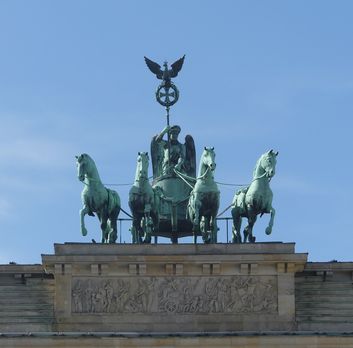
To round off the discussion of symbols in this article, I’ll finish with the Brandenburg Gate, Berlin’s most iconic landmark if ever there was one. So let’s talk about the quadriga. The qua, what? The quadriga, the emerald-green chariot right at the top.
Well, the funny thing is that the symbolism here has changed meaning at least twice. Until 1806, it symbolised peace, but Napoleon had it dismantled and taken to Paris. In the return match, the Prussian Empire took its revenge: Napoleon was defeated, and the quadriga returned. It was modified slightly by adding an Iron Cross and the Prussian eagle. It no longer represented peace, but Prussian victory and power.
Another “amusing” little detail: the quadriga faces east, towards the seat of power at the time, and thus later towards the GDR.
Conclusion
It’s true that by tackling a historical subject in Berlin, we were running the risk of ending up with anecdotes that wouldn’t make for a stand-up show! Anyway, the good news is that in 2026, even though some people still harbour a few repugnant ideas, Berlin is a dynamic and innovative capital that has managed to reclaim its history, often for good causes.
We can therefore imagine that, in a few years’ time, when an author like myself examines the hidden symbols on Berlin’s monuments, there will be examples symbolising hope, friendship between peoples, freedom, the end of wars, and so on.
Berlin is still brimming with hidden symbols that you only notice if you take the time to look closely. Please feel free to share your own discoveries in the comments.